
Last updated July 13, 2026
Seasonal Garage Door Care for Worcester: Year-Round Homeowner’s Guide
Here’s something that surprises most Worcester homeowners: the two months that generate the most garage door service calls in our area are March and November. Not the dead of winter, not the height of summer — the transition months. After eight years of running service calls across Worcester, from Tatnuck to Greendale to Vernon Hill, Richard Anderson has tracked this pattern consistently. These aren’t random failures. They’re the predictable result of maintenance routines that ignore how dramatically Worcester’s four seasons stress every moving part on a garage door system. This guide maps what to do, when to do it, and why skipping even one season costs you more than the 20 minutes it takes to prevent it.
Quick Answer
Seasonal garage door maintenance in Worcester means four distinct routines per year: fall weatherstripping inspection before freeze-thaw cycles begin, winter monitoring of spring tension and opener strain, spring hardware checks for salt corrosion and frost heave damage, and summer humidity management for wooden doors and seal adhesion. A 20-minute seasonal walk-around catches most issues before they become emergency service calls.
Table of Contents
- Why Worcester’s Seasons Hit Garage Doors Harder Than You Think
- Fall Prep: The Most Important Six Weeks of the Year
- Winter Survival: What Cold Actually Does to Your Door
- Spring Assessment: After the Damage Is Done
- Summer Humidity: The Hidden Season for Worcester Doors
- The 20-Minute Seasonal Walk-Around Routine
- Common Mistakes to Avoid
- When to Call a Professional
- Frequently Asked Questions
Why Worcester’s Seasons Hit Garage Doors Harder Than You Think
Worcester sits at 480 feet above sea level with a continental climate that delivers temperature swings of 40 degrees inside a single week, sometimes inside 48 hours. That thermal whiplash isn’t just uncomfortable — it’s mechanical stress on every component of a garage door system.
Here’s what we see in the field that generic maintenance guides miss:
- Freeze-thaw cycling: Worcester averages 48 freeze-thaw cycles annually. Each cycle expands and contracts the concrete slab, the door frame, and the track mounting points. By November, gaps open. By March, they’ve cycled dozens of times.
- Road salt migration: In neighborhoods near major routes like Park Avenue or Chandler Street, airborne salt from winter road treatment corrodes hardware faster than inland areas. We’ve replaced track brackets in Burncoat that looked five years older than identical hardware in Tatnuck.
- Humidity spikes: Worcester’s July and August average 72% relative humidity. Wooden door sections absorb moisture, swell, and stress hinges. Bottom seals lose adhesion as condensation forms behind them.
- Spring fatigue from cold: Torsion springs lose approximately 10% of their effective tension at 20°F versus 70°F. A door that “feels fine” in October is working your opener harder by January — and most homeowners don’t notice until the opener fails or the spring snaps.
The manufacturers’ generic “annual maintenance” recommendation assumes a temperate climate. Worcester isn’t temperate. In our experience, a door that gets one annual checkup in this market is running on borrowed time by year three.
Fall Prep: The Most Important Six Weeks of the Year
October 15 to November 30 is the critical window. Miss it, and you’re gambling with a mid-winter failure that almost always happens at the worst possible moment.
Why weatherstripping inspection matters more than anything else:
Worcester’s first sustained freeze typically arrives in late November. If your bottom seal has gaps, cracks, or has pulled away from the retainer, that freeze-thaw cycle starts working on your garage interior immediately. We’ve opened doors in December where the bottom seal had failed in October, and the resulting ice buildup had frozen the door to the slab. The homeowner didn’t notice until they hit the opener button and stripped the drive gear.
Your fall checklist:
- Inspect the bottom seal in full light. Look for compression set (permanent flattening), cracking at the fold points, and detachment from the retainer channel. In Worcester, PVC seals last 3-4 years; EPDM rubber lasts 5-7. If you’re unsure of age, replace it.
- Check side and top weatherstripping. The vinyl or rubber seal against the door frame should rebound when compressed. If it stays flat, it’s hardened and leaking air.
- Lubricate all moving parts with silicone-based spray. Avoid WD-40 — it attracts dust and gums up in cold. We use Lubriplate or similar on LiftMaster and Chamberlain opener chains and screws.
- Test the auto-reverse. Place a 2×4 flat on the floor centered under the door. The door should reverse on contact. If it doesn’t, the force setting or safety sensors need adjustment. This isn’t optional — it’s Massachusetts child-safety code.
- Inspect cables for fraying. Look especially where cables wrap around the bottom drum. Any fraying means replacement, not “watching it.”
Fall prep in Worcester neighborhoods: In areas with mature tree cover like Indian Lake or Salisbury Street, check photo-eye sensors for leaf debris accumulation. A single wet leaf can throw a false obstruction signal that has you troubleshooting the wrong problem at 7 AM.
Winter Survival: What Cold Actually Does to Your Door
January and February in Worcester average lows of 16-18°F. Those temperatures change how your garage door system behaves, and the signs of stress are specific.
Spring tension and cold:
Torsion springs are calibrated at room temperature. For every 10°F below 70°F, spring steel loses roughly 1-2% of its torque output. A door balanced perfectly in September feels heavier to the opener by February. You’ll see this as:
- The opener straining — motor housing runs hot, you smell ozone
- Jerky opening motion instead of smooth acceleration
- The door stopping short of full open, or reversing unexpectedly
Critical safety note: Torsion springs store massive mechanical energy. Never attempt to adjust spring tension yourself. The winding bars can slip, and the resulting release of energy causes serious injury or death annually. If your door feels heavy or the opener is struggling, that’s a professional repair. Garage Door Repair in Worcester from a trained technician includes spring balance verification.
What to monitor yourself:
- Listen to the opener on the coldest mornings. A healthy system sounds the same at 15°F as at 50°F. If you hear grinding, laboring, or metallic clanking, something has changed.
- Check for ice damming at the threshold. Snow melt from your vehicle refreezes overnight. Use a plastic shovel, not metal, to clear it. Metal tools damage the bottom seal.
- Verify manual release function. The red emergency release cord should move freely. If it’s stiff, the mechanism may be icing internally.
- Inspect rollers monthly. Nylon rollers become brittle in extreme cold. Steel rollers can develop flat spots from sitting in one position. Either condition means replacement before spring.
In our 640 customer reviews, winter emergency calls consistently trace back to doors that showed warning signs in December. The homeowner noticed but “thought it could wait.” In Worcester, waiting costs you a frozen door on a morning when you’re already late.
Spring Assessment: After the Damage Is Done
March is our busiest service month. The freeze-thaw cycles have done their work, and everything fails at once — often during the first warm weekend when homeowners finally open the door for spring projects.
What winter actually damages in Worcester:
Salt corrosion on hardware: This is neighborhood-specific. Properties near I-290, I-190, or major state routes see accelerated corrosion on track brackets, hinges, and bottom fixtures. The salt doesn’t just rust — it swells hinge barrels, making the door operate stiffly. We’ve replaced entire hinge sets on 6-year-old doors in Main South that should have lasted 15.
Frost heave and track alignment: Worcester’s clay-heavy soils expand significantly when frozen. That expansion shifts garage slabs and wall framing. By March, we regularly find:
- Vertical tracks no longer plumb — the door binds on one side
- Header sag from frost-jacked framing, throwing off torsion spring alignment
- Rear track hangers pulled from joists as the structure settled unevenly
Your spring assessment routine:
- Visual sweep for rust. Any orange staining on hardware means active corrosion. Hit it with a wire brush and rust-inhibiting paint, or replace if pitting is visible.
- Check door balance with opener disconnected. The door should stay at half-open without drifting. If it falls or rises, spring tension is off.
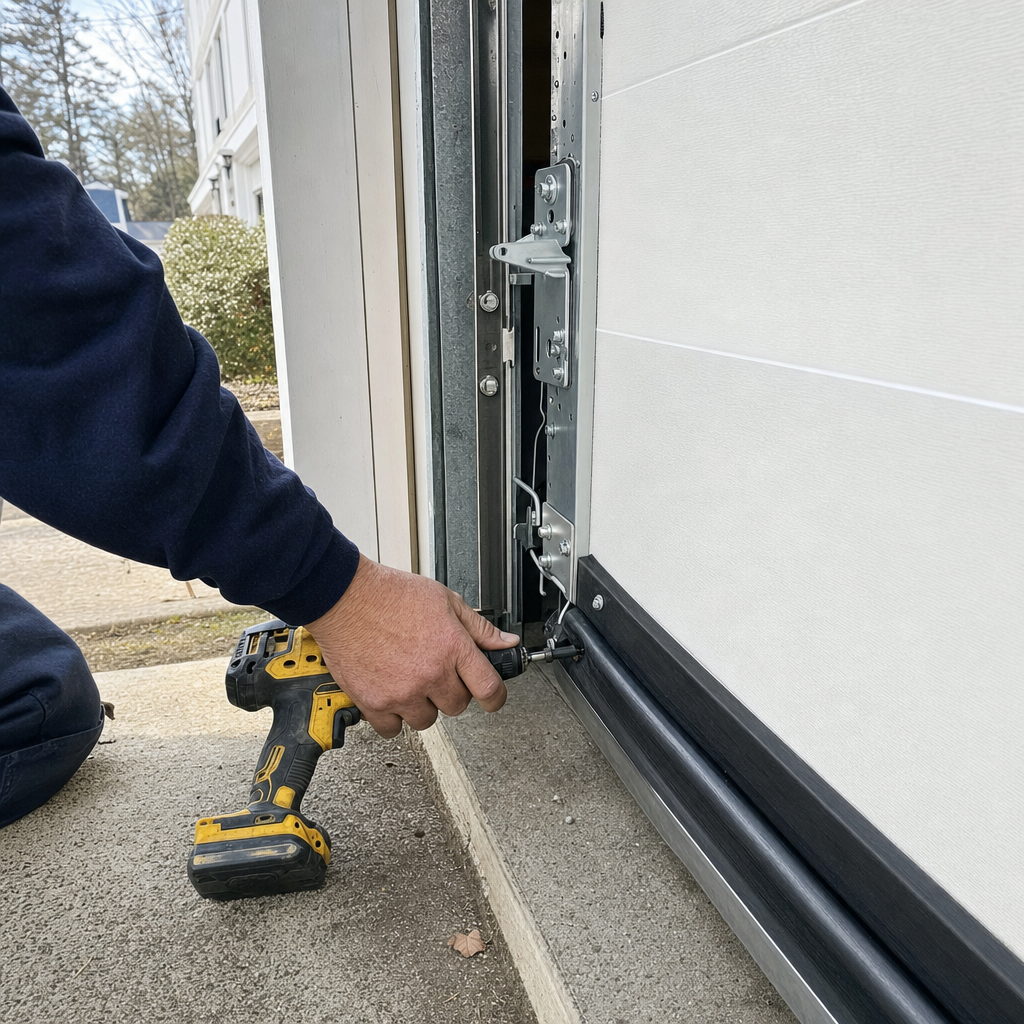
- Inspect all fasteners with a socket set. Track lag bolts, jamb brackets, and opener mounting hardware loosen from vibration and thermal cycling. Snug anything that turns freely — don’t over-torque.
- Test safety systems again. Photo eyes can shift from frost heave. The door should reverse when the beam is broken.
- Look at the door itself. Steel doors: check for paint bubbling (rust underneath). Wood doors: probe soft spots, check for delamination at panel joints. Fiberglass: stress cracks from thermal expansion.
Spring is also when we recommend scheduling professional service if you’ve skipped fall prep. Landmark Garage Door Installation Worcester home assessments include full balance testing, hardware torque verification, and opener force calibration — the checks that require specialized tools.
Summer Humidity: The Hidden Season for Worcester Doors
July and August don’t generate emergency calls like March and November, but they cause long-term damage that shows up as premature failure. Worcester’s summer humidity averages 72% — high enough to affect materials most homeowners assume are “weatherproof.”
Wooden door sections:
Even painted or stained wood absorbs atmospheric moisture. In Worcester’s older neighborhoods — Elm Park, University Park, areas with 1920s-era garages — we see original wooden doors that have cycled through humidity for decades. The damage pattern is predictable: panels swell in July, creating hinge binding; they shrink in October, revealing gaps that let in winter air. After enough cycles, the panel joints separate and the door becomes unrepairable.
If you own a wooden door, summer maintenance means:
- Checking that all panels move independently when the door is manually lifted
- Re-sealing any bare wood immediately — paint failure accelerates in humid conditions
- Ensuring drainage holes at the bottom of sections aren’t clogged, trapping moisture inside
Bottom seal adhesion failure:
The retainer channel that holds the bottom seal uses friction and sometimes adhesive. In sustained humidity, condensation forms between the seal and the retainer. By late summer, we’ve seen seals pull loose simply from the weight of trapped moisture. The fix is cleaning the channel with alcohol and reinstalling with fresh seal, or upgrading to a wider bulb seal that seats more positively.
Opener electronics:
Humidity affects circuit boards. Genie and older Chamberlain openers with wall-mounted controls can develop erratic behavior — phantom opening, failure to respond to remotes — that traces to moisture in the logic board housing. If your opener starts acting possessed in August, don’t replace it immediately. Check for condensation in the overhead unit first.
Summer is also ideal for Garage Door Installation in Worcester if replacement is needed. Dry conditions ensure proper seal seating, and you’ll enter winter with a door engineered for the climate.
The 20-Minute Seasonal Walk-Around Routine
This is the practical core. Four times yearly, spend 20 minutes. Not an hour. Not a weekend project. Twenty focused minutes, with a specific checklist for each season.
Universal steps (all seasons):
- Disconnect opener and operate door manually — should move smoothly through full travel
- Visually inspect cables, springs, and hardware from a safe distance
- Test auto-reverse and photo-eye function
- Listen for grinding, squealing, or metallic clanking
- Check weatherstripping integrity at all edges
Season-specific additions:
| Season | Additional Focus | What You’re Preventing |
|---|---|---|
| Fall (Oct-Nov) | Bottom seal replacement if aged; lubrication of all moving parts; photo-eye cleaning | Freeze-thaw seal failure; winter opener strain |
| Winter (Jan-Feb) | Ice clearance at threshold; opener strain listening; roller brittleness check | Slab freezing; opener gear failure; roller cracking |
| Spring (Mar-Apr) | Rust treatment; fastener torque check; balance verification; track plumb check | Corrosion failure; hardware loosening; spring snap |
| Summer (Jul-Aug) | Wood seal inspection; bottom seal adhesion; opener electronics condensation check | Panel delamination; seal dropout; control board failure |
Document what you find. A simple phone note with the date and any observations creates a maintenance history that helps tremendously when you do call for service. “The door started binding in March after running smooth in January” tells a technician exactly where to look.
For opener-specific maintenance, Garage Door Opener in Worcester service from Landmark includes chain/belt tension verification, force limit calibration, and travel limit adjustment — the settings that drift seasonally but aren’t homeowner-adjustable on most modern units.
Common Mistakes to Avoid
- Using WD-40 as garage door lubricant. It’s a solvent, not a lubricant. It strips existing grease, attracts dust, and turns to gum in Worcester’s cold. Use silicone spray or white lithium grease on tracks and rollers.
- Ignoring a “slightly” heavy door. In Worcester’s cold, that heaviness means your opener is doing spring work. Opener replacement costs $350-$650; spring adjustment costs a fraction of that. The heavy door always wins if you wait.
- Power-washing the door to “clean” it. High-pressure water forces moisture into track housings, behind weatherstripping, and into wooden panel joints. Use a sponge and mild detergent, or a low-pressure garden hose.
- Testing auto-reverse with a hand or foot. Massachusetts code requires a solid object test for a reason. Body parts get injured. Use a 2×4 or manufactured test block.
- Assuming all brands age the same. A 10-year-old Raynor steel door in Tatnuck with minimal salt exposure may outlast a 7-year-old door on Chandler Street. Location and exposure matter more than brand alone.
- Waiting for “annual” maintenance in a four-season climate. The generic advice doesn’t apply here. Worcester’s thermal cycling demands quarterly attention, not yearly neglect.
- DIY spring repair after watching online videos. Every year, emergency rooms in Worcester County treat injuries from failed spring winding attempts. The videos don’t show the accidents. This is not a cost-saving opportunity — it’s a risk that isn’t worth it.
When to Call a Professional
Some maintenance is homeowner-appropriate. Some isn’t. Here’s the dividing line:
Call when: A spring is broken or the door feels unbalanced; cables are frayed or off the drum; the opener strains, reverses unexpectedly, or fails to move the door; tracks are visibly bent or out of plumb; there’s been impact damage from a vehicle; or you’ve performed seasonal maintenance and something still isn’t right.
Richard Anderson personally handles diagnostic calls as both owner and lead technician. That means the person assessing your door is the same person who authorizes the repair scope and stands behind the work. No subcontractor handoffs, no “the crew will handle it.”
Landmark Garage Door Installation Worcester offers free estimates in Worcester — call (877) 586-6414. We’re factory-trained on 8 major brands including LiftMaster, Chamberlain, Genie, Clopay, Amarr, Wayne Dalton, Craftsman, and Raynor, and we stock parts for same-trip resolution on most common failures.
Frequently Asked Questions
Professional seasonal tune-ups in the Worcester market typically run $89-$150 for a standard residential door, with premium multi-point inspections on complex systems reaching $200. Many homeowners offset this by handling the quarterly walk-around themselves and calling for professional service only when they find something beyond basic maintenance. Call (877) 586-6414 for an exact quote — estimates are free.
About 80% of seasonal maintenance is homeowner-appropriate: visual inspection, lubrication, weatherstripping replacement, and safety testing. The remaining 20% — spring balance adjustment, cable replacement, track realignment, and opener force calibration — requires specialized tools and training due to injury risk. We’ve responded to emergency calls in Worcester where a well-intentioned DIY attempt turned a $150 adjustment into a $600 repair.
March combines the accumulated damage of winter freeze-thaw cycling with the first heavy use of spring projects. November represents the last chance to address seal and hardware issues before they’re locked in by sustained cold. Both months are transition periods where deferred maintenance meets seasonal stress — and the door loses.
With proper seasonal maintenance, a quality steel door should last 20-30 years in Worcester; wood doors average 15-20 with diligent sealing; and openers typically run 10-15 years. Without maintenance, we’ve replaced 8-year-old doors in Burncoat that should have lasted decades. The climate is harsh, but it’s predictable — and predictability means preventability.
Repair is usually more economical when the door structure is sound and the failure is isolated to springs, cables, rollers, or an opener. Replacement makes sense when panels are delaminating, multiple hardware points are corroded, or repair costs exceed 50% of a new door installed. For a door over 15 years old with multiple issues, we typically recommend replacement. Call (877) 586-6414 for an honest assessment — we’ll tell you if repair is the better value.
Yes. Emergency garage door service is available for urgent failures — when the door won’t move, when a spring has snapped and the door is hanging, or when the opener has failed and your vehicle is trapped. Richard Anderson responds directly as owner and lead technician, not a rotating on-call crew. Call (877) 586-6414 and describe the failure; we’ll prioritize based on security and safety risk.
The Bottom Line
Worcester’s garage doors don’t fail randomly. They fail predictably, in patterns we’ve tracked across eight years and 640 customer interactions. March and November don’t have to be emergency months. A 20-minute seasonal walk-around, four times yearly, catches the salt corrosion before it seizes a hinge, the seal gap before it freezes the door to the slab, and the spring fatigue before it snaps at 6 AM on a Tuesday.
The maintenance isn’t complicated. It requires attention to how this specific climate stresses these specific components. Do the work yourself where it’s safe. Call a professional where the risk exceeds the savings. And don’t let a generic “annual maintenance” schedule written for San Diego guide your door through a Worcester winter.
Written by Richard Anderson, Owner & Lead Technician at Landmark Garage Door Installation Worcester, serving Worcester since 2018.