
Last updated July 13, 2026
The Complete Guide to Garage Door in Worcester
Most Worcester homeowners spend more time picking a paint color than choosing a garage door — then call a repair company 18 months later wondering why it’s already failing. In a city where January temperatures regularly drop below 10°F and road salt hangs in the air from November through April, your garage door isn’t a cosmetic afterthought. It’s exterior infrastructure that takes a beating most manufacturers don’t design for. Over the past eight years installing and repairing doors across Worcester’s triple-deckers, colonials, and capes, we’ve learned that the right door, properly specified and installed, lasts 20–30 years. The wrong one? You’ll know by the second winter.
Quick Answer
A quality garage door installation in Worcester costs between $1,200 and $3,800 depending on size, material, and insulation level, with most residential replacements falling in the $1,800–$2,600 range. Steel doors with 24- or 25-gauge construction, thermal-break frames, and quality bottom weatherstripping perform best in Worcester’s freeze-thaw climate. The installation requires a building permit when the door opening is modified, and choosing a multi-line dealer who stocks parts matters more here than in milder climates — because when a spring fails at 5°F, you don’t want to wait two weeks for a special order.
Table of Contents
- How Worcester’s Climate Destroys the Wrong Garage Door
- Steel, Wood, or Composite: What Actually Works Here
- Door Styles That Fit Worcester’s Housing Stock
- Garage Door Openers: What Worcester Homeowners Overlook
- Permits, Inspections, and Contractor Red Flags
- How to Read a Garage Door Quote in Worcester
- Common Mistakes to Avoid
- When to Call a Professional
- Frequently Asked Questions
How Worcester’s Climate Destroys the Wrong Garage Door
Worcester sits 480 feet above sea level with an average of 64 inches of snow annually and temperature swings that can hit 40°F in a single day during shoulder seasons. That freeze-thaw cycle is the silent killer of garage doors, and most failures we see in neighborhoods like Tatnuck, Greendale, and Indian Lake trace back to climate-related material stress.
Here’s what actually happens:
- Bottom rail rot and seal failure: Road salt gets tracked into garages on tires and boots, then melts into a corrosive slurry that eats standard vinyl weatherstripping. By March, we see doors in Worcester with cracked, hardened seals that let wind-driven snow pile against the interior panel.
- Panel seam separation: Steel doors with poor thermal breaks allow interior and exterior surfaces to expand and contract at different rates. After three to four Worcester winters, the paint cracks at seams and moisture wicks into the core.
- Hardware fatigue: Standard zinc-plated hinges and rollers corrode faster here than in drier climates. In Burncoat and Vernon Hill, we regularly replace hardware that should have lasted a decade but failed in five years.
- Opener strain: Cold-stiffened springs and binding tracks force openers to work harder, burning out motors prematurely.
The specification that matters most is one most homeowners never hear about: thermal-break construction. A thermal-break door has a polymer barrier between the inner and outer steel skins, preventing direct thermal bridging. Without it, the exterior skin can be 20°F colder than the interior skin on a Worcester January morning — that differential stress is what warps panels and cracks paint over time.
Bottom weatherstripping spec is equally critical. We specify dual-durometer EPDM rubber with an integrated thermal plastic elastomer (TPE) edge, rated to -40°F. Standard PVC seals turn rigid around 20°F — useless for a Worcester February.
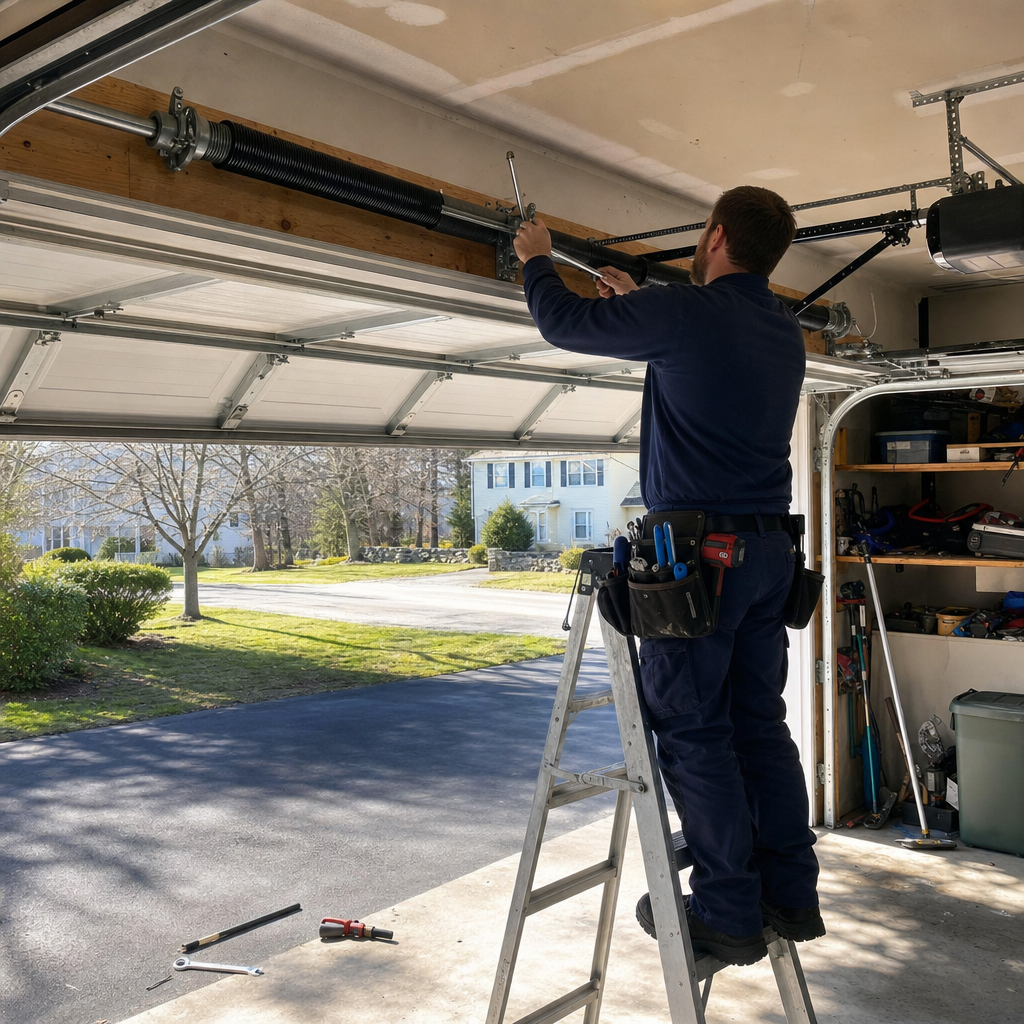
Garage Door Repair in Worcester becomes necessary far sooner when climate-appropriate specs are skipped at installation.
Steel, Wood, or Composite: What Actually Works Here
We’ve installed and serviced doors across every major material type in Worcester. Here’s the ground truth after eight years of callbacks and warranty work:
Steel (Most Common, Most Variable)
Steel dominates for good reason — when specified correctly. The gauge matters enormously: 24-gauge or thicker for single-layer doors, 25-gauge minimum for insulated sandwich construction. Big-box specials often use 27- or 28-gauge steel that dents from basketball impacts and flexes in wind.
Insulation value is measured in R-value, but the real number to watch is the polyurethane core density. A 2-inch door with 1.5 lb/ft³ polyurethane outperforms a 2-inch door with 1.0 lb/ft³ foam, even at the same R-value rating, because the denser foam adds structural rigidity that resists panel bowing.
For Worcester, we typically specify:
- 24- or 25-gauge exterior skin minimum
- 1.75″ to 2″ total thickness with polyurethane core
- Thermal-break construction (not just “insulated”)
- Galvanized or zinc-aluminum coated hardware, not standard zinc-plated
- EPDM or silicone weatherstripping, never PVC in exposed applications
Wood and Wood Composite
Real wood carriage-house doors look exceptional on Worcester’s older colonials and Victorians, but they’re maintenance-intensive. We’ve replaced wood doors in College Hill and Main South that rotted at the bottom rail within six years because the homeowner never resealed the end grain. If you choose wood, budget for resealing every 18–24 months, and specify a composite or PVC bottom rail — the part that actually contacts moisture.
Fiberglass composites (like Clopay’s Canyon Ridge) offer the wood aesthetic with better moisture resistance, though they can become brittle in extreme cold. We’ve had good results with these in sheltered applications; exposed installations facing west into winter wind have shown more stress.
Aluminum and Glass
Contemporary full-view aluminum doors are trending, but they’re poorly suited to Worcester’s climate unless specified with thermal-break frames and insulated glass. We’ve seen condensation pooling in non-thermal aluminum tracks, then freezing and jamming the rollers. If you want this look, the upcharge for thermal-break specification is non-negotiable here.
Door Styles That Fit Worcester’s Housing Stock
Worcester’s housing market has distinct architectural DNA, and garage doors that ignore it hurt resale value. Here’s what we’ve observed installing across the city’s neighborhoods:
Triple-Deckers (Three-Decker Houses)
Common in Vernon Hill, Main South, and Greendale, these 1880–1930 structures often have detached or semi-detached garages in back alleys. The garage is typically utilitarian — a single door, 8′ or 9′ wide, sometimes with a low header height. Flush or short-raised-panel steel doors in white, almond, or gray blend appropriately. Ornate carriage-house styling looks out of place on a structure that shares a driveway with two other units.
Colonials and Capes
Worcester’s post-war suburbs — Tatnuck, Indian Lake, Burncoat — are full of 1950s–1980s colonials and capes with attached front-facing garages. These are the doors that dominate curb appeal. Long-raised-panel or recessed-panel designs in deeper colors (forest green, burgundy, navy) complement the traditional architecture. We’ve found that insulated steel with a wood-grain texture satisfies the aesthetic without the maintenance burden — particularly important given Worcester’s snow load and salt exposure.
Victorians and Older Homes
In neighborhoods like Salisbury Street and parts of West Side, original carriage houses or later additions need doors that respect the period detail. Overlay or carriage-house designs with decorative hardware work when proportioned correctly — but we’ve corrected too many installations where an oversized 16′ door with fake strap hinges overwhelmed a narrow carriage-house opening. Scale matters more than style.
What Hurts Resale
From conversations with Worcester real estate agents and our own observations: mismatched styles (modern full-view on a colonial), doors that clearly came from a big-box special order without trim integration, and visible deterioration — peeling paint, dented panels, failed seals. A quality door properly maintained signals that the home’s infrastructure has been cared for.
Garage Door Installation in Worcester should always include a style consultation that accounts for your specific neighborhood context, not just your personal preference.
Garage Door Openers: What Worcester Homeowners Overlook
The opener is where many Worcester installations fall short — either underpowered for the door weight, or lacking features that matter in a cold-climate garage. After servicing hundreds of openers across the city, here’s what we prioritize:
Motor Size and Door Weight
A ½-horsepower opener handles most single 8’×7′ steel doors adequately. But add insulation, a steel-back construction, or a heavier carriage-house overlay, and you’re at the motor’s limit. In Worcester, where cold-stiffened springs and slightly binding tracks add load, we spec ¾ HP for any insulated double door and for all wood-composite doors. The marginal cost difference ($80–$120) prevents premature motor failure.
Drive Type: Belt, Chain, or Screw
Belt drive (rubber-reinforced belt) is our default recommendation for attached garages — quieter operation, less vibration transmitted to living spaces above. Chain drive remains acceptable for detached garages and is more tolerant of slight track misalignment (common as Worcester’s frost heave shifts garage slabs). Screw drive has largely been discontinued by major manufacturers; we don’t recommend it for new installations.
Smart Features That Actually Matter
Wi-Fi connectivity for smartphone control is standard on most mid-tier and premium openers now (LiftMaster’s myQ, Chamberlain’s equivalent). In Worcester, the feature we emphasize is vacation mode and remote disable — because garage doors are a common entry point for break-ins, particularly in areas with alley-access garages. Battery backup is increasingly important as well; Massachusetts code now requires it for new installations, and it’s essential if you rely on your garage as primary home access during storm outages.
Brand Fluency Matters for Repairs
We’re factory-trained on LiftMaster, Chamberlain, Genie, Clopay, Amarr, Wayne Dalton, Craftsman, and Raynor — which means when your opener fails, we can source parts and diagnose without a learning curve. A contractor who only knows one brand line will either replace what could be repaired or order parts that take weeks. In a Worcester January, that’s not acceptable.
Garage Door Opener in Worcester selection should match your door weight, garage configuration, and how you actually use the space — not just what’s on sale.
Permits, Inspections, and Contractor Red Flags
Worcester’s building permit requirements for garage doors catch many homeowners off guard — and create an easy way to spot contractors cutting corners.
When You Need a Permit
Under Worcester’s building code, a permit is required when:
- The door opening is being modified in width or height (structural alteration)
- A new door is being installed in a previously blank wall (new opening)
- The installation involves electrical work for a new opener circuit (not plug-in replacement)
A straight replacement — same size door, same opener location, no structural changes — technically falls under maintenance and typically does not require permitting. However, many contractors won’t touch this distinction, either demanding permits unnecessarily (adding cost) or avoiding the question entirely.
The Red Flag: “We Don’t Pull Permits”
If a contractor suggests skipping a required permit to save money or time, that’s a hard stop. Unpermitted structural modifications can void homeowner’s insurance, create liability if someone is injured, and complicate resale — Worcester buyers and their inspectors increasingly check permit history. We’ve been called to correct installations where the header was inadequately supported after a height modification, creating a sagging opening and binding door within two years.
What Proper Permitting Looks Like
A legitimate contractor in Worcester will:
- Clearly state whether your project requires a permit before quoting
- Include permit fees as a line item (typically $50–$150 for garage door work) or specify if homeowner is responsible for pulling
- Schedule and pass required inspections
- Provide documentation for your records
At Landmark Garage Door Installation Worcester home, we handle permitting for projects that require it and document the status for those that don’t — no ambiguity.
How to Read a Garage Door Quote in Worcester
Quotes for garage door installation in Worcester vary widely — we’ve seen $1,100 and $3,500 for ostensibly the same project. The difference is in what’s actually specified, what’s omitted, and what’s buried in vague language. Here’s how to read one like a technician:
Line Items That Should Appear
| Line Item | What to Verify | Typical Worcester Range |
|---|---|---|
| Door (size, model, gauge, insulation) | Specific model number, not “premium steel door” | $800–$2,200 |
| Track and hardware | Galvanized or coated; roller count and type | $180–$350 |
| Spring system | Torsion vs. extension; cycle rating (10K minimum) | $200–$400 |
| Opener (if included) | HP, drive type, brand, model, features | $350–$700 |
| Weatherstripping | Type, temperature rating, warranty | $60–$120 |
| Removal and disposal | Old door, track, opener | $100–$200 |
| Labor | Hourly rate or flat fee; what’s excluded | $400–$800 |
| Permit (if required) | Who pulls it; inspection scheduling | $50–$150 |
Vague Language That Signals Trouble
- “Commercial-grade” or “heavy-duty” without specific gauge or model numbers — meaningless marketing terms
- “All hardware included” without specifying galvanized vs. standard, roller type, or spring cycle rating
- “As needed” for any line item — opens the door to mid-project upsells
- “Standard weatherstrip” — in Worcester, standard often means PVC that fails in year two
- No mention of spring cycle rating — 10,000 cycles is minimum; 25,000–30,000 is worth the upgrade for daily-use doors
The quote should read like a specification sheet, not a sales brochure. If you can’t compare it item-by-item against another quote, you’re not getting enough information to make an informed decision.
Common Mistakes to Avoid
- Choosing based on door panel appearance alone. We’ve replaced beautiful carriage-house doors in Worcester that failed in four years because the homeowner prioritized style over thermal-break construction and gauge specification. The door you don’t notice — because it just works — is the better long-term choice.
- Ignoring the garage’s interior temperature. If you heat your garage or have living space above it, an uninsulated or poorly sealed door drives energy costs up dramatically. In Tatnuck and West Side homes with converted garage-adjacent rooms, we’ve seen heating bills drop 15–20% after proper door and weatherstripping upgrades.
- Letting a general contractor sub out garage door work. The GC’s “guy” is often whoever was cheapest that week, not a specialist. When the track needs adjustment or the opener malfunctions, that subcontractor may be unresponsive or gone entirely. Richard Anderson serves as both owner and lead technician — the person who quotes your job is the person who installs it and takes your call if something needs attention.
- Buying from a big-box store without local installation support. The door arrives, the installer is a third-party contractor with no brand training, and when a panel dents or hardware fails, you’re navigating two separate warranty systems. A multi-line dealer who stocks parts and knows your specific door model resolves issues in one visit.
- Skipping the spring upgrade. Standard 10,000-cycle springs last 7–10 years for typical use. For $80–$120 more, 25,000-cycle springs extend that to 15–20 years — and in Worcester’s climate, where cold starts add stress, that upgrade pays for itself.
- Not verifying what’s included in “installation.” Some quotes exclude opener removal, old door disposal, or trim repair. We’ve arrived at jobs where the homeowner expected a turnkey replacement and the previous contractor left a pile of debris and a gaping hole.
- Waiting for catastrophic failure. A door that groans, shudders, or reverses intermittently is telling you something. In Worcester’s winter, that warning becomes an emergency when the door won’t close during a storm and you’re leaving for work. Address symptoms early — the repair is almost always cheaper than the emergency call.
When to Call a Professional
Some garage door issues are maintenance items a homeowner can handle — lubricating hinges, testing photo-eye alignment, clearing track debris. Others require trained technicians, both for safety and because improper repair often causes costlier damage.
Call a professional immediately for:
- Broken or visibly frayed torsion or extension springs — these are under extreme tension and can cause serious injury or death if handled incorrectly
- Door that won’t stay open, closes too rapidly, or reverses unpredictably — indicates spring or opener malfunction
- Bent or detached track sections — operating the door can cause panel damage or derailment
- Opener motor that hums but doesn’t move the door — potential gear failure or stripped drive
- Any door failure that traps a vehicle inside or leaves the garage unsecured overnight
Richard Anderson, Owner & Lead Technician at Landmark Garage Door Installation Worcester, personally handles emergency garage door service calls across the city. When the door won’t move, you’re not waiting for a dispatcher to find an available crew — you’re speaking with the technician who will arrive at your home. We offer free estimates for installation and replacement projects in Worcester; call (877) 586-6414 to schedule.
Frequently Asked Questions
Most residential garage door installations in Worcester range from $1,800 to $2,600 for a quality insulated steel door with standard hardware and opener. Basic single-layer steel doors start around $1,200; premium insulated doors with high-cycle springs and smart openers can reach $3,800. Call (877) 586-6414 for an exact quote based on your door size and configuration — estimates are free.
A properly specified and installed garage door lasts 20–30 years in Worcester. The critical factor is climate-appropriate specification: thermal-break construction, quality weatherstripping rated to subzero temperatures, and galvanized or coated hardware. We’ve replaced doors in Greendale and Burncoat that failed in 8–12 years because they lacked these specifications — usually big-box specials installed without local climate consideration.
A straight replacement — same size door, no structural changes — typically does not require a permit. You need a Worcester building permit if you’re modifying the opening dimensions, creating a new opening, or running new electrical for an opener. Any contractor who won’t discuss permitting status clearly is a red flag. At Landmark, we handle permits for qualifying projects and document exemption status for straightforward replacements.
Repair is cheaper when the door itself is sound — typically panel replacement, spring or cable replacement, track realignment, or opener repair. Replacement makes sense when the door is over 15 years old, has multiple failing panels, lacks insulation you now need, or has outdated hardware that’s no longer compatible with modern openers. In Worcester’s climate, we often see doors that are structurally compromised by rust or seal failure where repair is a temporary fix at best. We’ll assess honestly and recommend replacement only when it’s the better long-term value.
We offer emergency garage door service for urgent failures — doors that won’t close and leave your home unsecured, springs that have broken and trapped vehicles, or openers that have failed completely. For standard repair requests, we typically schedule within 24–48 hours. Our parts specialist scope means we stock common springs, cables, rollers, and opener components, so most repairs complete in a single visit. Call (877) 586-6414 to check same-day availability for your specific issue.
We recommend belt-drive openers with ¾ HP motors, battery backup, and Wi-Fi connectivity for most Worcester attached garages. The belt drive runs quieter — important with living spaces above — and the higher horsepower handles cold-stiffened doors without strain. LiftMaster and Chamberlain both offer models with these specifications that we’ve installed extensively across Worcester. For detached garages where noise is less critical, a ½ HP chain drive with battery backup is a cost-effective alternative. The key is matching motor power to actual door weight, not assuming one size fits all.
The Bottom Line
Choosing a garage door in Worcester is an infrastructure decision, not a product purchase. The right specification — thermal-break steel, quality weatherstripping, appropriate insulation, and hardware rated for New England’s salt and freeze-thaw cycles — determines whether your door lasts two decades or needs replacement before you’ve paid off the financing. The right installer matters equally: someone who understands Worcester’s permit requirements, stocks parts for same-trip resolution, and stands behind the work personally. Richard Anderson has built Landmark Garage Door Installation Worcester on exactly that model — owner accountability, multi-brand expertise, and 640 customers and counting who’ve experienced the difference.
Ready to discuss your garage door project? Call (877) 586-6414 for a free estimate. We’ll assess your specific door, your garage’s conditions, and your usage patterns — then recommend what’s actually appropriate, not what’s most profitable.
Written by Richard Anderson, Owner & Lead Technician at Landmark Garage Door Installation Worcester, serving Worcester since 2018.