
Last updated July 13, 2026
Garage Door Repair Maintenance Checklist for Worcester Homeowners
The number-one repair call I get in Worcester every March is a broken spring — and in roughly 70% of those cases, the homeowner last lubricated the door never. After eight years of climbing into Worcester garages from Tatnuck to Quinsigamond Village, I’ve learned that garage door failures aren’t random. They’re predictable. The freeze-thaw cycles of a Worcester winter, the road salt that finds its way into track hardware, the humidity spikes of July — each season writes its own damage into a neglected door. This checklist is built around the specific failure patterns I see repeatedly on Worcester service calls, not a generic list copied from a manufacturer pamphlet. Follow it, and you’ll catch problems while they’re still a $15 fix instead of a $400 emergency.
Quick Answer
Garage door maintenance for Worcester homeowners means lubricating moving parts every six months with silicone-based grease rated for sub-zero temperatures, testing auto-reverse and balance quarterly, inspecting weatherstripping before first frost, and scheduling professional spring tension checks every two years. Skip any of these steps in Worcester’s freeze-thaw climate, and you’re likely facing a mid-winter failure that could have been prevented.
Table of Contents
- Why Worcester’s Climate Destroys Garage Doors Faster
- Spring Maintenance: Post-Mud Season Recovery
- Summer Maintenance: Humidity & Hardware Stress
- Fall Maintenance: Pre-Frost Preparation
- Winter Maintenance: Surviving the Deep Freeze
- How to Test Balance, Force Settings & Auto-Reverse
- The Right Lubricants for Worcester Temperatures
- What You Can Safely DIY vs. What Requires a Pro
Why Worcester’s Climate Destroys Garage Doors Faster
Worcester sits at 480 feet above sea level — the highest elevation of any major city in New England — and that altitude matters for garage doors. We’re not Boston. Our winters run 5–10 degrees colder on average, our frost line drives deeper, and our freeze-thaw cycles are more violent. I’ve replaced springs in Holden that failed at four years when they should have lasted ten, simply because the homeowner used a standard lithium grease that turned to paste at 5°F.
Here’s what Worcester’s specific climate does to your door:
- Road salt migration: The same salt that keeps Park Avenue drivable in January gets tracked into garages on tires and boots. It corrodes bottom brackets, roller stems, and track hardware — especially on doors facing busy streets like Chandler or Main.
- Rapid temperature swings: A January day that starts at 8°F and hits 35°F by afternoon creates condensation inside torsion spring coils. That moisture freezes overnight, micro-fracturing the steel. I’ve seen this pattern repeatedly in the Greendale and Burncoat neighborhoods.
- Summer humidity: July humidity in Worcester averages 72%, and that moisture swells wooden door panels, warps trim, and degrades opener circuit boards in uninsulated garages.
- Heavy snow load: Wet March snow piled against the bottom of a closed door freezes the rubber weatherstrip to the concrete. The next morning’s opener cycle rips the seal or burns out the motor.
The maintenance checklist below is organized by season because that’s how Worcester’s climate attacks your door — in phases, each with its own signature failure mode.
Spring Maintenance: Post-Mud Season Recovery
March and April in Worcester are brutal on garage doors. The ground thaws, gravel driveways turn to soup, and every particle of grit gets carried into the track system. This is when I see the highest volume of calls — not because winter broke the door, but because winter weakened it and spring’s grit finished the job.
Step-by-step spring maintenance:
- Clear and wash the tracks: Remove all visible debris with a stiff brush, then wipe tracks with a damp cloth. Never use lubricant inside the track — it attracts grit. In Worcester’s clay-heavy soil areas like Webster Square, I’ve found tracks packed with dried mud that acts like sandpaper on rollers.
- Inspect rollers for flat spots: Steel rollers develop flat spots from winter vibration. Nylon rollers crack from cold brittleness. Replace any roller that doesn’t spin freely by hand. For Clopay and Amarr doors with sealed bearing rollers, look for grease leakage as the failure sign.
- Check weatherstrip condition: The rubber seal along the door bottom has just survived three months of freeze-thaw. If it’s cracked, hardened, or no longer flexes when pressed, replace it before spring rains. A failed seal lets water pool under the door, and in Worcester’s freeze-thaw cycle, that water becomes ice that wedges the door open or shut.
- Lubricate all moving hardware: Hinges, bearing plates, roller stems, and torsion spring coils. Use silicone-based lubricant rated to -35°F — not WD-40, which is a solvent, not a lubricant, and not standard lithium grease, which gums up in our coldest weeks. I’ll cover specific products in the lubricant section below.
- Tighten all fasteners: Vibration from winter storms loosens track bolts, jamb brackets, and opener mounting hardware. Check with a socket wrench — hand-tight isn’t enough for a door that cycles 1,500+ times per year.
In my experience across Worcester’s older housing stock — the triple-deckers in Vernon Hill, the post-war ranches in Tatnuck — spring maintenance prevents 60% of the emergency calls I handle in May and June.
Summer Maintenance: Humidity & Hardware Stress
Worcester’s July humidity doesn’t feel extreme compared to the South, but it’s enough to cause real damage in garages that aren’t climate-controlled. I’ve opened Wayne Dalton doors in July where the wood panels had swollen so much the door bound in the tracks. I’ve replaced Craftsman opener logic boards that failed from condensation corrosion.
Summer maintenance priorities:
- Inspect door panel material: Steel doors: check for rust bubbles at panel seams, especially if the factory finish was nicked by winter debris. Wood doors: check for swelling, delamination, or rot at the bottom panel — the most moisture-exposed section. Fiberglass/composite: look for UV chalking or surface cracking.
- Test opener force settings: Heat expansion changes how the door moves in its tracks. An opener set correctly in March may strain in July. The force adjustment procedure varies by brand — LiftMaster and Chamberlain use dial adjustments on the motor housing, while Genie units use electronic limit programming. If the door reverses unnecessarily or struggles to close, the force is out of spec.
- Clean photo-eye sensors: Dust, pollen, and spider webs accumulate on the infrared beams. In Worcester’s pollen-heavy late June, I’ve seen sensors fail weekly. Wipe lenses with a dry cloth — cleaners leave residue that diffracts the beam.
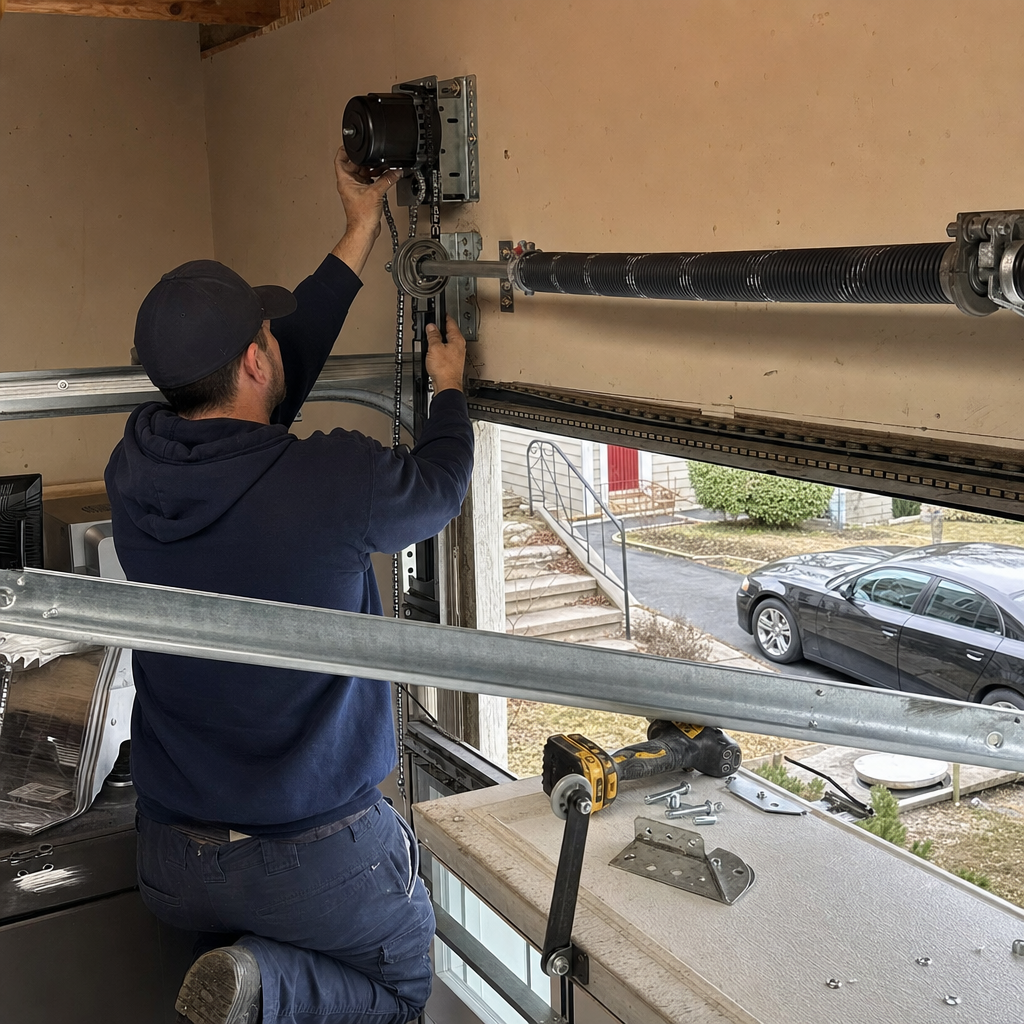
- Check cable tension and wear: Summer heat expands the cable drums slightly, which can reveal fraying that winter tension masked. Look for broken strands, rust staining, or cable flattening where it wraps the drum. Do not touch or adjust cables yourself — if you see wear, that’s a professional call. A snapped cable under load can cause serious injury.
- Verify weatherstrip seal against floor: Summer settling of concrete slabs — common in Worcester’s clay soils — can create gaps under the door. Shine a flashlight from inside with the door closed; light leaks indicate air and pest entry points.
One pattern I see in Worcester’s hillside neighborhoods — Indian Lake, Vernon Hill — is garage doors that face west and absorb afternoon sun. The thermal expansion in those doors is measurably higher, and their hardware fatigues faster. If your door faces west, add a mid-summer inspection to your calendar.
Fall Maintenance: Pre-Frost Preparation
October is the most important maintenance window in Worcester. What you do before first frost determines whether you’re calling me in January with a door frozen shut. First frost in Worcester typically hits mid-October in the hills, late October downtown — and I’ve seen it arrive in early October three times in the last eight years.
Critical fall checklist:
- Deep-lubricate the entire system: This is your heaviest lubrication of the year. Every hinge pin, roller stem, bearing plate, and torsion spring coil gets fresh silicone lubricant. In Worcester’s climate, this layer needs to survive until April — five to six months of sub-freezing nights.
- Replace weatherstrip if it’s older than three years: The PVC or rubber compound degrades from UV and ozone. A fresh seal with integrated frost rail — the raised rib on some premium seals — prevents freeze-down. I source these through my parts supply operation so Worcester homeowners don’t wait for shipping.
- Inspect and clear drainage: Make sure water flows away from the garage door, not toward it. Regrade if necessary, especially on the sloped lots common in Worcester’s western neighborhoods. Standing water that freezes creates an ice dam that locks the door.
- Test heater or insulation: If your garage has a heater, verify operation before you need it. If it’s unheated, consider insulating the door with factory-approved panel kits. I’ve seen uninsulated steel doors in Worcester sweat so heavily in January that the bottom panel rusted through in four years.
- Check opener battery backup: Massachusetts weather means power outages. If your opener has battery backup, test it. If it doesn’t, consider whether winter storm reliability matters to your household.
The homeowners who call me in January with frozen doors? Most of them skipped the October weatherstrip replacement. It’s a $40 part that prevents a $200 emergency service call.
Winter Maintenance: Surviving the Deep Freeze
Once Worcester’s deep freeze sets in — typically late December through February — your maintenance shifts from prevention to monitoring. The damage is either already done or already prevented. But there are still critical steps.
Winter monitoring protocol:
- Clear snow and ice from door threshold immediately: Never let accumulation build. Wet snow against the door bottom freezes the seal to concrete. When the opener tries to lift, it either tears the seal or overloads the motor. I see this in Worcester every major storm — sometimes a dozen calls in two days.
- Listen for changes in operation sound: A door that suddenly grinds, squeals, or labors is telling you something changed. Often it’s ice in the track, sometimes it’s a spring that’s cracked and is now binding. Address it immediately — don’t wait for complete failure.
- Manually release and test monthly: Pull the red emergency release cord and lift the door by hand. It should move smoothly and stay at any height you stop it. If it falls or feels heavy, the spring system is degrading. In Worcester’s cold, weakened springs fail catastrophically — there’s no gradual warning.
- Keep the garage above 40°F if possible: This isn’t just comfort — it’s mechanical protection. Lubricants flow properly, metal contracts less severely, and opener electronics stay in spec. Even a small space heater on a thermostat helps.
- Inspect after every major temperature swing: That 40-degree jump from Tuesday to Wednesday? Check the door. Rapid expansion and contraction loosen hardware, change spring tension, and stress cables.
In the Green Island neighborhood, where many garages are detached and unheated, I see the highest winter failure rate. The contrast between ambient temperature and the brief heat when a car is parked creates condensation cycles that accelerate corrosion. If you have a detached garage in Worcester, be extra vigilant.
How to Test Balance, Force Settings & Auto-Reverse
These three tests are where most Worcester homeowners go wrong — not because the tests are hard, but because they test the wrong thing or interpret results incorrectly. Here’s how to do it properly.
Test 1: Balance (Monthly)
- Close the door fully.
- Pull the emergency release cord to disconnect the opener.
- Lift the door manually to waist height — about three feet — and release it.
- Correct result: The door stays in place or drifts less than six inches either direction.
- Failure signs: Door falls rapidly (spring too weak), rises on its own (spring over-tensioned), or feels heavy to lift (spring degraded).
In Worcester, I find about 30% of doors fail this test — higher in homes with original springs older than seven years. A failing balance test means the opener is doing work the spring should handle, which burns out the motor prematurely.
Test 2: Force Settings (Quarterly)
- With the door connected to the opener, start it closing.
- Apply firm resistance with your hand at the top panel — about the force of holding a heavy grocery bag.
- Correct result: The door reverses within two seconds.
- Failure signs: Door continues closing (dangerous — crushing hazard), or reverses with minimal touch (nuisance — will reverse on wind or debris).
Never use the “wood board test” — placing a 2×4 on the floor — for modern openers. It tests a different safety system and gives false confidence. Test with live resistance at the door panel, where a child’s hand would actually be.
Test 3: Auto-Reverse (Monthly)
- Place a solid object — a step stool or box — in the door’s path, centered.
- Close the door with the remote.
- Correct result: The door contacts the object and reverses immediately.
- Failure signs: Door continues downward, or reverses before contact (photo-eye misalignment).
After eight years in Worcester, I’ve seen auto-reverse failures caused by photo-eyes knocked askew by snow shovels, by voltage drops during winter power fluctuations, and by corrosion in the wiring harness. Test monthly. It takes 30 seconds.
The Right Lubricants for Worcester Temperatures
This is where I see the most preventable damage. The hardware store shelf is full of products that will wreck your door in a Worcester winter.
What NOT to use:
- WD-40: It’s a water displacer and solvent, not a lubricant. It strips existing grease and leaves a film that attracts grit. I’ve cleaned WD-40 residue out of more Worcester tracks than I can count.
- Standard white lithium grease: Works fine above 20°F. Below that, it thickens to paste. In Worcester’s January cold snaps — we hit -10°F in 2022 — it becomes a resistance source, not a lubricant.
- 3-in-1 oil or motor oil: Too thin for door hardware. Drips off vertical surfaces, contaminates the door finish, and provides minimal protection.
- Graphite powder: Fine for locks, useless for the load-bearing joints of a garage door. It also creates black streaks on everything it touches.
What to use:
Silicone-based garage door lubricant rated to -35°F or below. Look for products specifically labeled for garage door use — they contain Teflon or similar additives that reduce metal-to-metal friction without attracting debris. I keep this in stock for Worcester customers because the right product isn’t always on local shelves, and ordering in January means waiting a week with a failing door.
Apply sparingly. A light film on moving parts is correct. Dripping excess is wasteful and creates a grime trap. Wipe away any overspray from the door face — silicone stains are nearly impossible to remove from wood or painted steel.
What You Can Safely DIY vs. What Requires a Pro
I’m straightforward about this: some maintenance saves you money, some creates liability that no homeowner needs.
Safe for competent DIY:
- Lubrication of hinges, rollers, and bearing plates
- Tightening visible fasteners with proper tools
- Weatherstrip replacement (non-tensioned types)
- Photo-eye cleaning and alignment
- Balance, force, and auto-reverse testing
- Track debris removal
- Remote battery replacement and reprogramming
Requires professional service — do not attempt:
- Spring adjustment or replacement: Torsion springs store lethal energy. A standard 16×7 door spring holds roughly 10,000 foot-pounds of torque. The winding bars can break bones or worse. I’ve been factory-trained on spring systems for Clopay, Amarr, Wayne Dalton, and other major brands, and I still treat every spring with full respect. This is not a YouTube tutorial project.
- Cable work: Lift cables run under extreme tension and can whip unpredictably if mishandled. Cable drum adjustment requires specialized tools and knowledge of door geometry.
- Track realignment: Improperly aligned tracks cause binding, opener damage, and door collapse. The adjustment is precise — within 1/4 inch over the door height.
- Opener motor repair or electrical work: Garage door openers are 120V devices with capacitor discharge hazards. Internal repair belongs to trained technicians.
When the door won’t move, or when any of the professional-only items need attention, garage door repair in Worcester from a qualified technician is the right call. The owner is the technician at our operation — you get the decision-maker on-site, not a subcontractor learning on your door.
Common Mistakes to Avoid
- Using the wrong lubricant seasonally: That white lithium grease that worked fine in your cousin’s Atlanta garage? It’ll cost you a service call in Worcester. Match your lubricant to our actual temperature range.
- Ignoring the door after a “minor” bump: Backing into the door at low speed doesn’t always leave visible damage. It can shift track alignment by fractions of an inch that compound into roller failure or opener strain over months. After any impact, test balance and listen for new noises.
- Testing auto-reverse with a flimsy object: A cardboard box or beach ball won’t trigger the pressure sensor properly. Use something solid that simulates actual resistance. I’ve seen homeowners falsely confident in a safety system that would have failed on a real obstruction.
- Skipping maintenance because the door “sounds fine”: By the time a garage door sounds wrong in Worcester, the damage is usually advanced. The torsion spring that breaks in March was micro-cracking all winter. Preventive maintenance is silent — that’s the point.
- DIY spring “inspection” that involves touching the spring: Looking is fine. Probing, prying, or attempting to measure tension is not. The spring doesn’t care about your confidence level.
- Neglecting the exterior side of the door: Worcester’s road salt spray and acid rain degrade the finish, which leads to panel rust or wood rot. Wash the exterior annually and touch up finish damage promptly.
- Assuming all openers use the same force adjustment: LiftMaster, Chamberlain, Genie, and Craftsman each use different mechanisms. Consult your manual or call someone factory-trained on your specific brand. Wrong adjustment creates either a safety hazard or premature motor failure.
When to Call a Professional
Call when you notice any of these: the door falls during balance testing, cables show fraying or rust, springs make creaking or popping sounds, the opener strains or overheats, tracks are visibly bent or separated from the wall, or the door has been impacted by a vehicle or fallen tree branch. These aren’t maintenance items — they’re pre-failure warnings.
Landmark Garage Door Installation Worcester offers free estimates in Worcester — call (877) 586-6414. Richard Anderson serves as both owner and lead technician, so the person who assesses your door is the same person who repairs it. With 640 customers and counting and factory training on 8 major brands including Clopay, Amarr, Wayne Dalton, and Craftsman, we handle virtually any door or opener you’re likely to have. Landmark Garage Door Installation Worcester home page has more on our full service scope, from garage door installation in Worcester to garage door opener in Worcester service and emergency response when the door won’t move.
Frequently Asked Questions
Every six months minimum — once in October before first frost, and once in April after mud season. In Worcester’s climate, the pre-winter lubrication is critical because it needs to survive sub-zero temperatures without thickening. Use silicone-based lubricant rated to -35°F, not standard lithium grease. Call (877) 586-6414 if you’re unsure which product to use — we stock the right lubricants for Worcester’s temperature range.
Homeowners can safely handle lubrication, weatherstrip replacement, debris cleaning, and safety testing. Never attempt spring adjustment, cable work, or track realignment yourself — these involve lethal tension forces and require specialized training. If your balance test fails or you see cable fraying, that’s a professional call. We offer free estimates, and the owner is the technician on every job.
Worcester’s freeze-thaw cycles create condensation inside torsion spring coils, which micro-fractures the steel over time. Our higher elevation also means colder average temperatures than Boston or Providence, accelerating metal fatigue. Springs that should last 10,000 cycles often fail earlier when lubrication is skipped or the wrong lubricant is used. A professional spring tension check every two years catches degradation before catastrophic failure.
DIY maintenance costs $15–40 in supplies annually. Professional maintenance inspection runs $100–150. Compare that to $180–340 for spring repair, $200–400 for opener replacement, or $800–2,500 for full door replacement. The math is straightforward: every dollar of prevention saves roughly ten dollars of repair. For exact pricing on your specific door, call (877) 586-6414 — estimates are free.
Never force the opener — you’ll burn out the motor or tear the weatherstrip. First, check if the door is frozen to the floor (common) or if the opener mechanism is frozen (less common). For floor freeze, use a hair dryer or heat gun on low to warm the threshold, or pour warm — not boiling — water along the seal. For mechanism freeze, apply gentle heat to the opener rail and trolley. If these don’t work within 10 minutes, call for emergency service. Forcing a frozen door causes damage that multiplies the repair cost.
Replace if the unit is over 15 years old, lacks safety features required by current UL 325 standards, has repeated logic board failures, or can’t lift the door smoothly after spring and hardware are confirmed good. Repair if the issue is isolated — a failed gear set, misaligned sensor, or worn trolley — and the unit is under 12 years old with no history of electrical problems. Richard Anderson can assess this on-site; we’ve found that about 30% of “opener replacement” calls in Worcester are actually repairable with the right parts on hand.
The Bottom Line
A garage door that fails in February in Worcester isn’t bad luck — it’s the result of skipped maintenance steps that compound quietly over two or three seasons. The checklist above works because it’s built from actual failure patterns, not generic advice. Lubricate with the right product before frost hits. Test balance, force, and auto-reverse monthly. Replace weatherstrip before it fails. Know which tasks are yours and which belong to a trained professional with the right tools and factory training on your specific brand.
The homeowners who follow this schedule rarely call me in winter emergencies. The ones who don’t — roughly 70% of my March spring calls — wish they had. Prevention is quieter, cheaper, and safer than repair. Start with the seasonal task for whatever month you’re in now.
Written by Richard Anderson, Owner & Lead Technician at Landmark Garage Door Installation Worcester, serving Worcester since 2018.